FTMO Challenge Case Study: How Four Automated Strategies Pass the Two-Step
Passing an FTMO Challenge is where most retail traders fail — not because they cannot make money, but because a single bad day breaches the drawdown rules and ends the evaluation. In this case study, we show how our four-strategy trading bundle is engineered to do the opposite: reach the profit target while keeping drawdown far inside FTMO’s limits.
Below, we break down the strategies, the technology that executes them, and the backtested and simulated results that make the FTMO Challenge a repeatable, rules-based process rather than a gamble.
What the FTMO Challenge Actually Requires
Before any strategy matters, you need to understand what you are being asked to do. The FTMO Challenge is a two-step evaluation, and every step is governed by three hard numbers:
- Profit target: +10% in Step 1, and +5% in Step 2.
- Maximum daily loss: 5% of the starting balance on any single day.
- Maximum overall loss: 10% of the initial balance at any point.
Importantly, there is no longer a time limit on either step. As a result, the real challenge is not speed — it is survival. A trader who never risks breaching the 5% daily or 10% overall loss will, eventually, reach the target. Therefore, our entire approach is built around risk control first and profit second.
The Foundation: The IQ TRADE Strategy on TradingView
Every trade in this case study originates from a single engine: our IQ TRADE strategy, coded in Pine Script and running natively on TradingView. It is not a single indicator. Instead, it is a multi-module signal system that combines trend, momentum and mean-reversion confirmation before it ever opens a position.
Because the logic lives on TradingView, each strategy is fully transparent and backtestable on years of historical data. Moreover, every bot uses a fixed take-profit and stop-loss with a small, constant risk per trade. There is no martingale, no grid, and no averaging into losing positions — the three habits that blow FTMO accounts fastest.
Four Strategies, One Account: The Bundle
Rather than betting the whole evaluation on one market, we run four independent strategies together on the same account. Each one trades a single currency pair with its own tuned parameters:
| Strategy | Pair | Direction | Take Profit | Stop Loss |
|---|---|---|---|---|
| Bot 1 | EUR/USD | Long | 0.40% | 0.10% |
| Bot 2 | EUR/USD | Short | 0.40% | 0.10% |
| Bot 3 | USD/JPY | Long & Short | 0.40% | 0.20% |
| Bot 4 | EUR/JPY | Long & Short | 0.80% | 0.50% |
This structure is deliberate. First, splitting EUR/USD into separate long-only and short-only bots means the two naturally offset each other when the market chops sideways. Next, USD/JPY and EUR/JPY add largely uncorrelated return streams from a different currency bloc. As a result, the combined equity curve is far smoother than any single strategy on its own — which is exactly what an FTMO evaluation rewards.
To keep risk balanced, EUR/JPY runs at a reduced position size compared with the other three, because its wider stop would otherwise add outsized swings to the basket.
From TradingView to MT5: How Our Bridge Executes Every Trade
A strategy is only useful if it can trade your funded account automatically. FTMO accounts run on MetaTrader, so we connect TradingView to MT5 through our own signal bridge. The pipeline works like this:
- The IQ TRADE strategy fires a TradingView alert the moment a signal triggers.
- That alert is sent to a secure webhook over an encrypted connection.
- Our MT5 bridge Expert Advisor receives the instruction and places, modifies or closes the trade on the FTMO account within seconds.
Crucially, each of the four strategies is tagged with its own magic number inside MT5. Consequently, every position is traceable to the exact bot that opened it, which makes risk monitoring and performance attribution straightforward. Because the whole chain is automated, there is no manual entry, no missed signal, and no emotional override — the three things that quietly sink most challenge attempts.
The Case Study: Backtested and Simulated Results
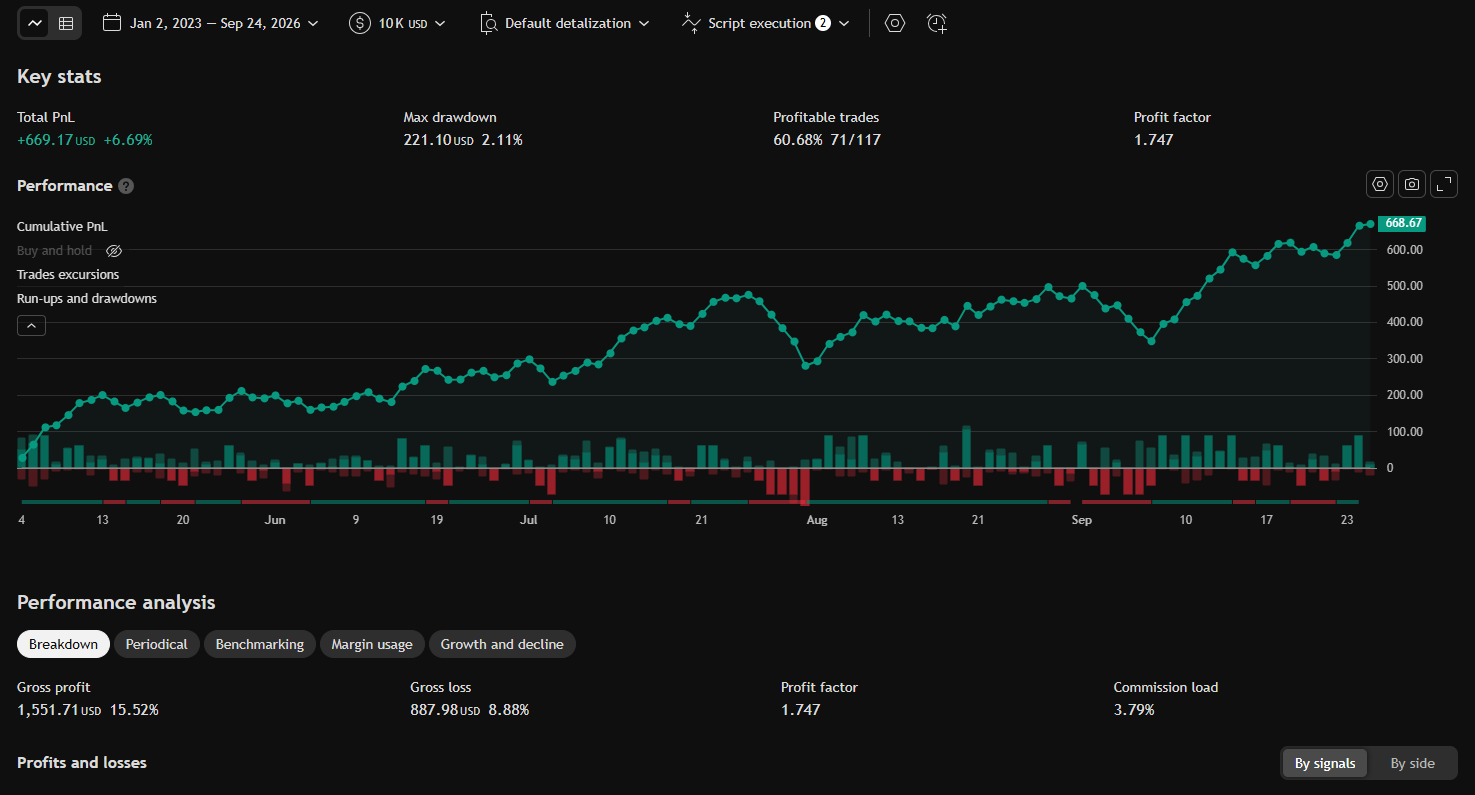
To test whether the bundle can genuinely pass the FTMO Challenge, we ran it across 3.7 years of historical data (January 2023 to September 2026) and then simulated a fresh evaluation starting on every single day in that window. Here is the combined picture:
| Metric (combined bundle) | Result |
|---|---|
| Test period | 3.7 years |
| Instruments | 4 currency pairs |
| Total trades | ~4,100 |
| Profitable months | 84% |
| Maximum drawdown | 4.5% (limit: 10%) |
| Worst single day | Under 2% (limit: 5%) |
| Return / drawdown (MAR) | ≈ 6 |
The most important number, however, comes from the walk-forward simulation. Across more than 860 historical start dates, the bundle reached the +10% Step 1 target without ever breaching the 5% daily loss or 10% maximum loss rule. In other words, in this dataset the only failure mode that ever mattered — a hard rule breach — did not occur at conservative sizing.
Why the Bundle Stays Inside FTMO’s Limits
The results above are not luck; they follow directly from the design. Specifically:
- Small risk per trade with tight, pre-defined stops means losses are capped before they can grow.
- Peak drawdown of about 4.5% sits at less than half of FTMO’s 10% ceiling, leaving a wide safety buffer.
- A worst day under 2% stays comfortably below the 5% daily-loss line.
- Diversification across pairs and directions smooths the equity curve and limits correlated losses.
How Long Does It Take to Pass the FTMO Challenge?
At conservative position sizing, the bundle historically reached the +10% Step 1 target in roughly two to three months (a median of about 80 days in simulation). Step 2, which only asks for +5%, typically completes faster. And because FTMO no longer enforces a deadline, the system can afford to trade patiently rather than force low-quality setups. Traders who accept a larger drawdown can size up to pass more quickly, but our default is to protect the account first.
Key Takeaways
- The FTMO Challenge is won by respecting risk limits, not by chasing fast profit.
- Four diversified strategies on one account produce a smoother, more survivable equity curve.
- Our TradingView-to-MT5 bridge executes every signal automatically, removing human error.
- In backtesting and walk-forward simulation, the bundle hit the target while keeping drawdown far inside the rules.
Frequently Asked Questions
Can an automated strategy really pass the FTMO Challenge?
Yes. A rules-based system that respects the daily and overall loss limits is well suited to the FTMO Challenge, because the evaluation rewards discipline and consistency — exactly what automation delivers.
Do I need both TradingView and MetaTrader?
Yes. The IQ TRADE strategy generates signals on TradingView, and our bridge passes them to your MetaTrader FTMO account for execution. Once configured, the process is hands-off.
Is this service affiliated with FTMO?
No. IQ TRADE is an independent product. We are not affiliated with, endorsed by, or sponsored by FTMO, and “FTMO” remains the trademark of its owner.
Are these results guaranteed?
No. The figures in this case study are backtested and simulated. They are hypothetical, and live results will differ. Trading always carries the risk of loss.
Ready to Put It to Work?
If you want a disciplined, automated route through the FTMO Challenge, our four-strategy bundle and MT5 bridge give you a repeatable framework built around the rules — not against them. Get in touch to learn more or explore our other automated trading strategies.
Risk disclaimer: The figures in this article are derived from historical backtesting on OANDA price data (January 2023 – September 2026) and from walk-forward simulation. Backtested and simulated results are hypothetical, do not represent actual trading, and are not a guarantee of future performance. Live results will differ because of spreads, slippage, execution quality, swaps and changing market conditions. Trading leveraged foreign exchange carries a substantial risk of loss and is not suitable for everyone. This article is for informational purposes only and is not financial or investment advice.