Case Study: ETHUSD 1H on Kraken
Can an ETHUSD trading bot beat simply holding Ethereum? In this case study we put that question to the test. We built a rules-based bot on the IQ TRADE STRATEGY, ran it on the 1-hour Kraken chart across nearly three years of data, and compared the result to buy-and-hold.
The headline: over the test window the bot returned +150%, while buying and holding ETH returned about +19%. Below we explain how we built it, what the backtest showed, and why we chose every setting — including the honest limitations.
The ETHUSD Trading Bot at a Glance
Our Ethereum bot is a focused configuration of the IQ TRADE STRATEGY, a Pine Script engine with 24 modular entry triggers. For crypto we kept only a small set of trend triggers and let the bot run around the clock.
Here is the short version:
- Market and chart: KRAKEN:ETHUSD, 1-hour candles.
- Direction: both long and short.
- Engine: MACD momentum plus Hull Moving Average triggers.
- Trading hours: 24/7, because crypto never closes.
- Risk model: a 1.5% stop loss and a 3.5% take profit.
How We Built the ETHUSD Trading Bot
We designed the bot around two facts about Ethereum: it trends powerfully, and it never stops trading.
Step 1: Size the Risk to Crypto Volatility
First, we set the risk model. Ethereum on the 1-hour chart swings far more than any forex pair, so a tight stop gets shaken out fast. Therefore we used a 1.5% stop loss paired with a 3.5% take profit, giving a strong reward-to-risk ratio above 2-to-1.
That ratio is the heart of the strategy. The bot expects to lose more trades than it wins, but each winner is meant to pay for more than two losers.
Step 2: Combine Momentum and Trend for Entries
Next, we chose the entry engine. Long trades fire on a MACD momentum trigger confirmed by a slow Hull Moving Average (length 89), so the bot only buys when both momentum and trend agree. Short trades use a very slow Hull trigger, which keeps shorts rare and high-conviction.
This asymmetry is deliberate. Ethereum spends more time rising than falling, so the bot leans long and treats shorts as the exception.
Step 3: Let It Run Around the Clock
Finally, crypto markets never close, so we removed the session and day filters entirely. The bot trades any hour of any day. It also runs live through a Kraken Futures webhook bridge, which turns each signal into a real order automatically.
Backtest Performance on the 1H Kraken Chart
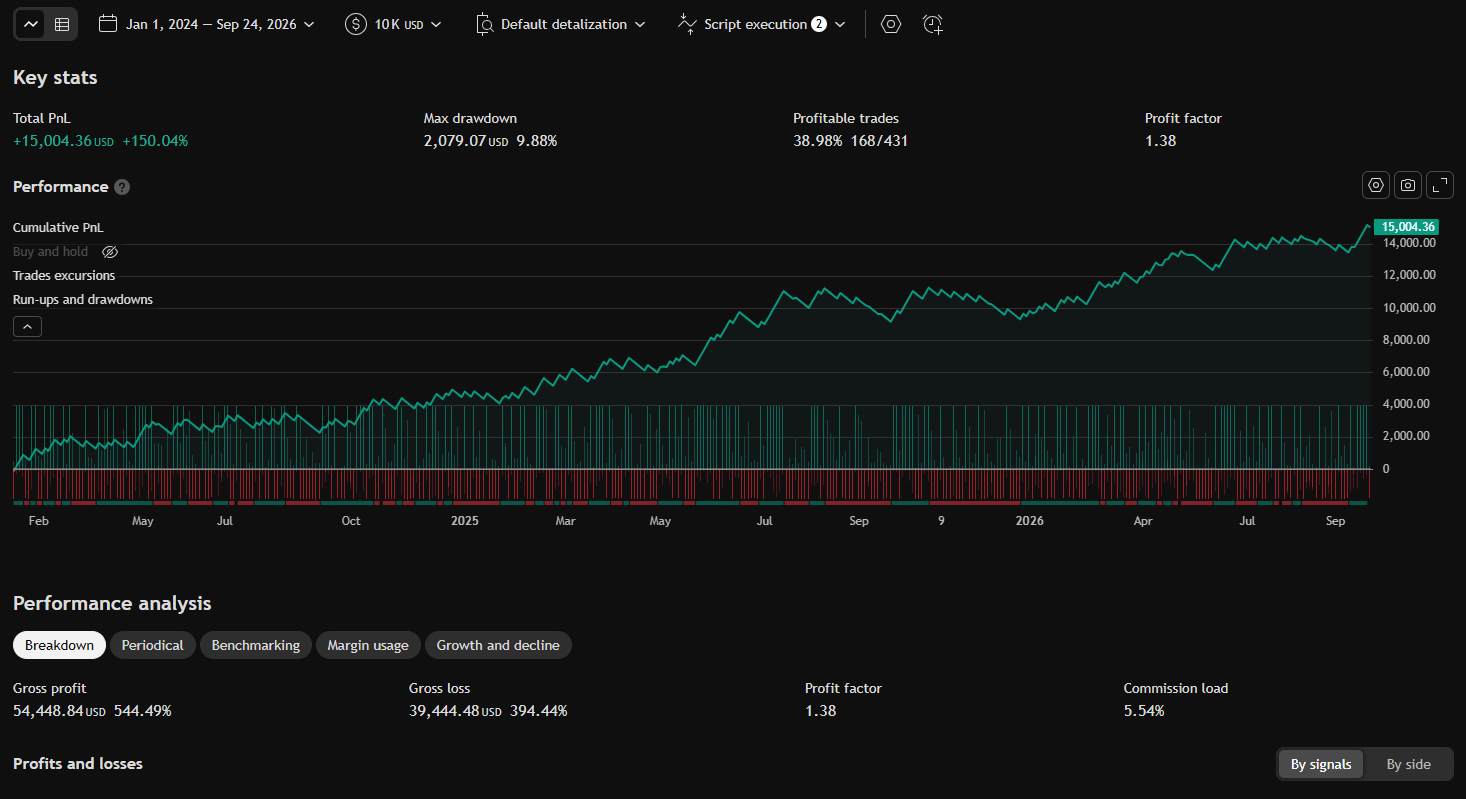
We ran the finished ETHUSD trading bot through the TradingView Strategy Tester on the Kraken feed. The test covered January 2024 to September 2026 — about 2.7 years and 431 trades — on a $10,000 account. Crucially, we included real commission of 0.035% per order, so these numbers are after trading costs.
Headline Results
| Metric | Result |
|---|---|
| Net profit | +$15,004 (+150%) |
| Annualised return (CAGR) | 39.8% |
| Profit factor | 1.38 |
| Sharpe ratio | 0.56 |
| Sortino ratio | 1.40 |
| Win rate | 38.98% |
| Average win / average loss | 2.16 |
| Max drawdown | 9.88% |
| Total trades | 431 |
| Commission paid | $3,019 (included above) |
It Beat Buy-and-Hold by a Wide Margin
Over the same 2.7 years, holding Ethereum returned about +18.96%. The bot returned +150% after costs — an outperformance of roughly 131 percentage points. In other words, the strategy did not just ride the market; it added real value on top of it.
Long and Short Both Made Money
The long side produced a 1.30 profit factor and +98%, while the rarer short side produced a stronger 1.78 profit factor and +52%. A bot that can profit in both directions is far more durable than one that only works in a bull market.
Parameter Analysis: Why Each Setting Matters
Every setting in this ETHUSD trading bot has a clear job. Here is the reasoning behind the important ones.
| Setting | Value | Why we chose it |
|---|---|---|
| Stop loss | 1.5% | Sized to Ethereum’s large 1-hour swings. |
| Take profit | 3.5% | A 2.3-to-1 reward target the bot’s winners can reach. |
| TP buffer | 0.5% | Banks the target slightly early to avoid near-misses. |
| Long engine | MACD + Hull 89 | Buys only when momentum and trend agree. |
| Short engine | Hull 500 | Keeps shorts rare and high-conviction. |
| Session filter | Off | Crypto trades 24/7, so no hours are excluded. |
| KC TrueRange filter | On | Screens entries by volatility quality. |
| Commission | 0.035% | Real Kraken cost, modelled so results are honest. |
The common thread is patience: wide stops, big targets, strict long confirmation, and a short side that only acts on strong signals.
Limitations and Honest Caveats
Even a strong, long-run backtest has boundaries. Here is what this result does not prove.
- The Sharpe ratio is modest. At 0.56, the equity curve is choppy, with drawdown stretches averaging around 13 days. Expect a bumpy ride, not a smooth line.
- The drawdown is real. A near-10% peak-to-trough loss is normal for a crypto trend system, but you must be able to sit through it.
- Slippage was set to zero. Commission is included, but real fills can still cost a little more, which trims the edge.
- No forward validation yet. The bot still needs walk-forward and out-of-sample testing before it should carry serious capital.
These caveats do not undermine the result. A 2.7-year sample that includes real costs and still beats buy-and-hold is genuinely encouraging — it simply is not a promise.
Key Takeaways
- Our ETHUSD trading bot returned +150% after costs over 2.7 years, versus about +19% for buy-and-hold.
- A reward-to-risk ratio above 2-to-1 let it profit with a sub-40% win rate.
- Real commission was included, which makes this backtest more trustworthy than a cost-free one.
- The trade-off is a choppy equity curve and a ~10% drawdown that a trader must be prepared to accept.
Frequently Asked Questions
What is an ETHUSD trading bot? It is an automated system that buys and sells Ethereum (ETHUSD) using fixed rules, executing trades without manual input.
Which timeframe and exchange does this bot use? It runs on the 1-hour chart using the Kraken ETHUSD feed, and it can execute live on Kraken Futures through a webhook bridge.
Does beating buy-and-hold in a backtest guarantee future profit? No. Backtests show past behaviour under set assumptions. Live markets bring new conditions, real slippage, and no guarantees.
Risk disclaimer: This article is a technical case study for educational purposes only. It is not financial advice or a recommendation to trade. Trading cryptocurrencies and leveraged products carries a high risk of loss. Past backtested performance does not guarantee future results. Never trade money you cannot afford to lose.