Case Study: BTCUSD Daily on Kraken
Most Bitcoin bots only work in a bull market. So for this case study we built a BTCUSD trading bot as a matched pair — one bot that trades only longs and one that trades only shorts — and ran both on the daily Kraken chart across 4.6 years of data.
The idea is simple. The long bot harvests Bitcoin’s big up-trends, while the short bot profits from the sharp corrections that punish buy-and-hold investors. Run together on one account, the pair returned roughly +188% after commission, versus about +107% for buy-and-hold — nearly double the return, while sitting in cash most of the time. Below we explain how we built each one, what the backtests showed, and why we chose every setting.
The BTCUSD Trading Bot Pair at a Glance
Both bots are configurations of the IQ TRADE STRATEGY, a Pine Script engine with 24 modular entry triggers. On the daily timeframe we kept only a handful of high-conviction trend and momentum triggers, so trades are rare but deliberate.
Here is the short version:
- Market and chart: KRAKEN:BTCUSD, daily candles.
- Structure: two separate bots — long-only and short-only.
- Engine: MACD, Ichimoku, trendline, and Hull triggers.
- Risk model: a 3% stop loss and a 6% take profit on both.
- Costs: real commission of 0.035% per order, included.
How We Built the BTCUSD Trading Bot
We designed the pair around one goal: capture Bitcoin’s trends in both directions while keeping drawdown far below buy-and-hold.
Step 1: Size the Risk to the Daily Chart
First, we set the risk model. Daily Bitcoin candles are large, so stops must be wide. Therefore both bots use a 3% stop loss and a 6% take profit, a clean 2-to-1 reward-to-risk ratio. On the daily chart, that gives each trade room to develop over several days.
Step 2: Build a Long Bot for Bull Trends
Next, we built the long side. It fires on a MACD momentum trigger, an Ichimoku trend trigger, and a trendline breakout, all confirmed by an automatic direction filter (DI+/DI−). As a result, the long bot only buys when several trend signals agree, which keeps it out of choppy phases.
Step 3: Build a Short Bot for Corrections
Then we built the short side separately. It uses a MACD short trigger, an Ichimoku short trigger, a Hull Moving Average trigger, and a bearish volume-divergence signal. That divergence module is key: it looks for rallies losing momentum, which often precede the corrections the short bot is designed to catch.
Step 4: Run Them as a Hedged Pair
Finally, we run both bots together. When Bitcoin trends up, the long bot works and the short bot stays flat. When Bitcoin corrects, the short bot works. Consequently, the pair aims for a smoother equity curve than holding Bitcoin through every swing.
Backtest Performance on the Daily Kraken Chart
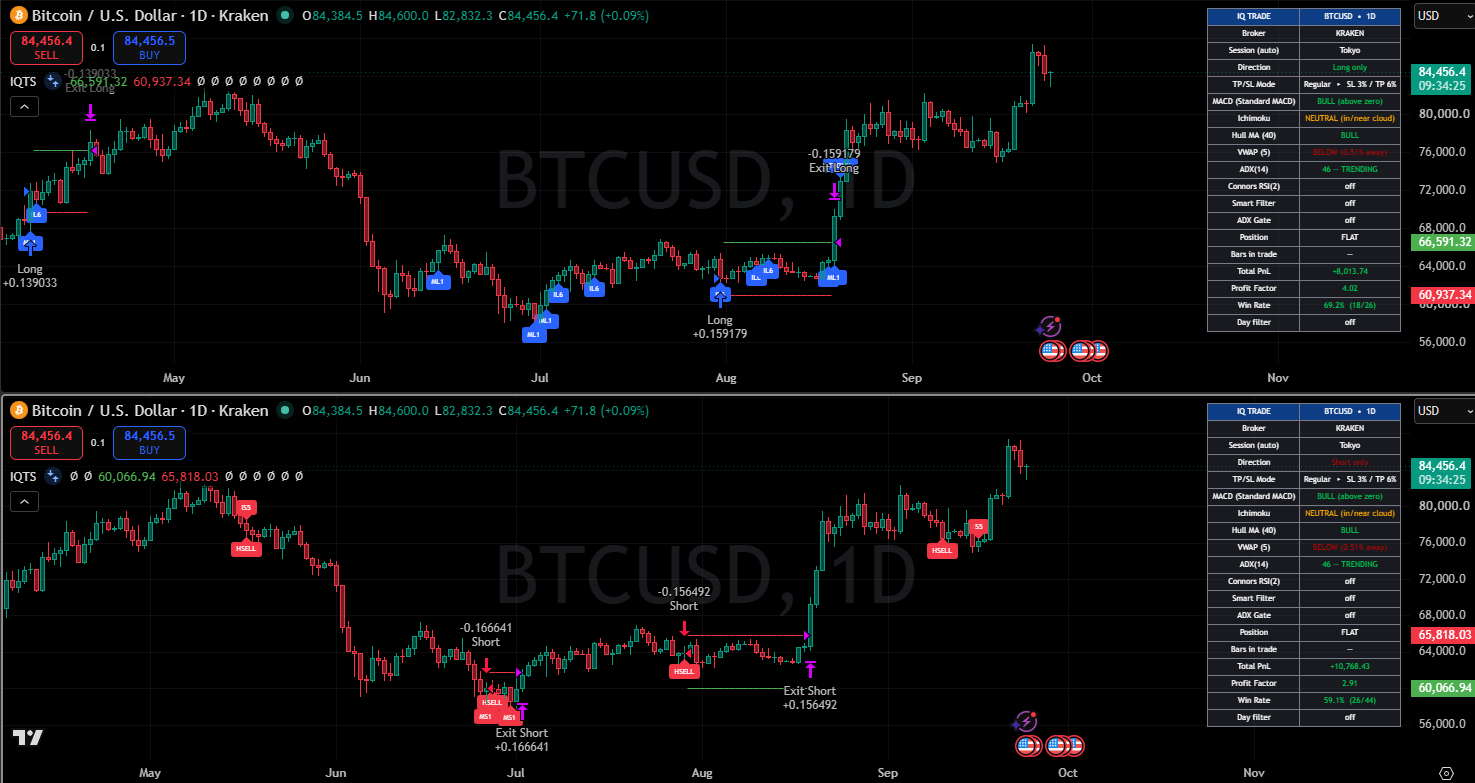
We ran both bots through the TradingView Strategy Tester on the Kraken feed, from early 2022 to September 2026 — about 4.6 years — on a $10,000 account each, with real commission included.
Side-by-Side Results
| Metric | Long bot | Short bot |
|---|---|---|
| Net profit | +80.1% | +107.7% |
| Profit factor | 4.02 | 2.91 |
| Win rate | 69.2% | 59.1% |
| Average win / average loss | 1.79 | 2.02 |
| Total trades | 26 | 44 |
| Max drawdown | 7.97% | 9.59% |
| Sharpe ratio | 0.35 | 0.35 |
| Sortino ratio | 0.94 | 1.07 |
Both bots were profitable across the full period. The long bot posted an exceptional 4.02 profit factor with a 69% win rate, while the short bot delivered +108% — remarkable for a short-only system during years when Bitcoin rose overall.
Combined, the Pair Nearly Doubled Buy-and-Hold
Here is the result that matters, because the two bots are designed to run together. On a single $10,000 account, their profits are effectively additive: the long bot added about +$8,014 and the short bot about +$10,768, for a combined +$18,782 — roughly +188% after commission.
Over the same window, simply holding Bitcoin returned about +107%. So the pair returned nearly double buy-and-hold.
Three facts make that outperformance stronger, not weaker:
- They rarely compete for capital. The long bot is in the market about 10% of the time and the short bot about 14%, and both are open at once on only about 3% of days. The pair earned ~1.8× buy-and-hold while sitting in cash roughly three-quarters of the time.
- Each side controls risk. The long bot’s max drawdown stayed under 8% and the short bot’s under 10% — far below Bitcoin’s own peak-to-trough falls over the period.
- They profit in opposite regimes. The long bot rides up-trends; the short bot monetises the corrections that holders simply have to endure.
For completeness and honesty: viewed in isolation, the long bot’s +80% lagged its own +107% buy-and-hold benchmark, as any stopped trend bot will during a strong bull run. But that is not how the system is deployed — long and short run together, and combined they clearly beat holding Bitcoin.
Parameter Analysis: Why Each Setting Matters
Every setting in this BTCUSD trading bot pair has a clear purpose. Here is the reasoning behind the important ones.
| Setting | Value | Why we chose it |
|---|---|---|
| Stop loss | 3% | Wide enough for daily Bitcoin candles. |
| Take profit | 6% | A 2-to-1 target that daily trends can reach. |
| Long triggers | MACD + Ichimoku + Trendline | Requires several trend signals to agree. |
| Short triggers | MACD + Ichimoku + Hull + divergence | Adds a momentum-loss signal before corrections. |
| Direction filter | DI+/DI− auto | Blocks trades against the prevailing trend. |
| KC TrueRange filter | On | Screens entries by volatility quality. |
| Commission | 0.035% | Real Kraken cost, so the results are honest. |
The theme is selectivity. On the daily chart the bots trade only a couple of dozen times across years, but each trade is backed by multiple aligned signals.
Limitations and Honest Caveats
Strong ratios on a daily chart come with real boundaries. Here is what these results do not prove.
- The sample is small. With just 26 long and 44 short trades over 4.6 years, the high profit factors carry wide uncertainty. A daily bot simply cannot produce hundreds of trades.
- The long bot lagged buy-and-hold. It controlled risk well, but it did not beat holding Bitcoin on raw return during a strong bull run.
- The short bot leaned on one big winner. A single +15% trade contributed a meaningful share of its profit. Remove that outlier and its edge is thinner.
- Slippage was zero and no forward test has run. Commission is included, but walk-forward and out-of-sample validation are still needed before serious capital.
None of this makes the pair weak. It means the honest verdict is “promising, risk-controlled, and worth forward-testing,” not “proven.”
Key Takeaways
- Run together, our BTCUSD trading bot pair returned roughly +188% over 4.6 years, versus about +107% for buy-and-hold — nearly double, after real commission.
- The pair achieved that while in the market only about a quarter of the time, with each bot’s drawdown under 10%.
- The long bot rides up-trends and the short bot profits from corrections, so they complement each other and rarely compete for capital.
- Small trade counts (26 long, 44 short) mean these results should be forward-tested before trusting them with size.
Frequently Asked Questions
What is a BTCUSD trading bot? It is an automated system that buys or sells Bitcoin (BTCUSD) using fixed rules, executing trades without manual input.
Why use separate long and short bots? Splitting the two lets each side specialise — the long bot rides up-trends, the short bot targets corrections — and lets you size or run them independently.
Did the bots beat holding Bitcoin? Yes — run together, the long and short bots returned roughly +188% versus about +107% for buy-and-hold, while in the market only about a quarter of the time. (The long bot alone lagged hodl, but the pair is designed to run together.) Backtests do not guarantee future results.
Risk disclaimer: This article is a technical case study for educational purposes only. It is not financial advice or a recommendation to trade. Trading cryptocurrencies and leveraged products carries a high risk of loss. Past backtested performance does not guarantee future results. Never trade money you cannot afford to lose.