
Case Study: XAUUSD 5M on OANDA
Building a profitable XAUUSD trading bot on a 5-minute chart is hard, because gold is fast, noisy, and unforgiving. In this case study we walk through exactly how we built one on the IQ TRADE STRATEGY, what the backtest showed on the OANDA feed, and why we chose every setting. We also share the honest limitations — because a case study that hides them is not worth reading.
Everything below comes from a single, reproducible TradingView Strategy Tester run. No numbers were rounded up, and no losing trades were hidden.
The XAUUSD Trading Bot at a Glance
Our gold bot is a configuration of the IQ TRADE STRATEGY, a Pine Script engine with 24 modular entry triggers and a full stack of filters. For this build we switched most of them off and kept only what gold rewards on the 5-minute timeframe.
Here is the short version:
- Market and chart: OANDA:XAUUSD, 5-minute candles.
- Direction: both long and short.
- Engine: Hull Moving Average trend triggers.
- Trade window: London and New York sessions only.
- Risk model: fixed 0.25% stop loss and 0.375% take profit.
The rest of this article unpacks each of those choices.
How We Built the XAUUSD Trading Bot
We did not start from a blank chart. Instead, we started from gold’s own behaviour and worked backwards to the settings.
Step 1: Match the Stop to Gold’s Real Volatility
First, we measured how far gold actually moves on a 5-minute bar. At a price near $4,300, a typical M5 bar spans roughly $5 to $8, which is about 0.12% to 0.18% of price during active hours.
That number drove the whole risk model. A stop tighter than one bar’s range gets hit by noise, so we set the stop at 0.25% (~1.5× the M5 range) and paired it with a 0.375% take profit. That gives a clean 1-to-1.5 reward-to-risk ratio with room to breathe.
Step 2: Pick an Engine That Suits a Trending Metal
Next, we chose the entry engine. Gold trends hard during London and New York, then chops in between. Therefore we used Hull Moving Average triggers, which react faster than a standard moving average and cut down on lag.
Crucially, we used the Hull settings asymmetrically:
- Long entries use a slow Hull (length 92), so the bot only buys confirmed up-trends.
- Short entries use a fast Hull (length 27) plus a reverse-Hull trigger (length 44), because gold tends to fall faster than it rises.
Step 3: Trade Only When Gold Is Liquid
Finally, we added time discipline. The bot trades Monday to Friday, only during the London and New York sessions, and it flattens every position 60 minutes before the 17:00 New York rollover. A swap-avoidance rule also blocks new trades around that rollover.
As a result, the bot never holds gold overnight and never pays a swap charge. That single rule removes a whole category of hidden cost and gap risk.
Backtest Performance on the 5M OANDA Chart
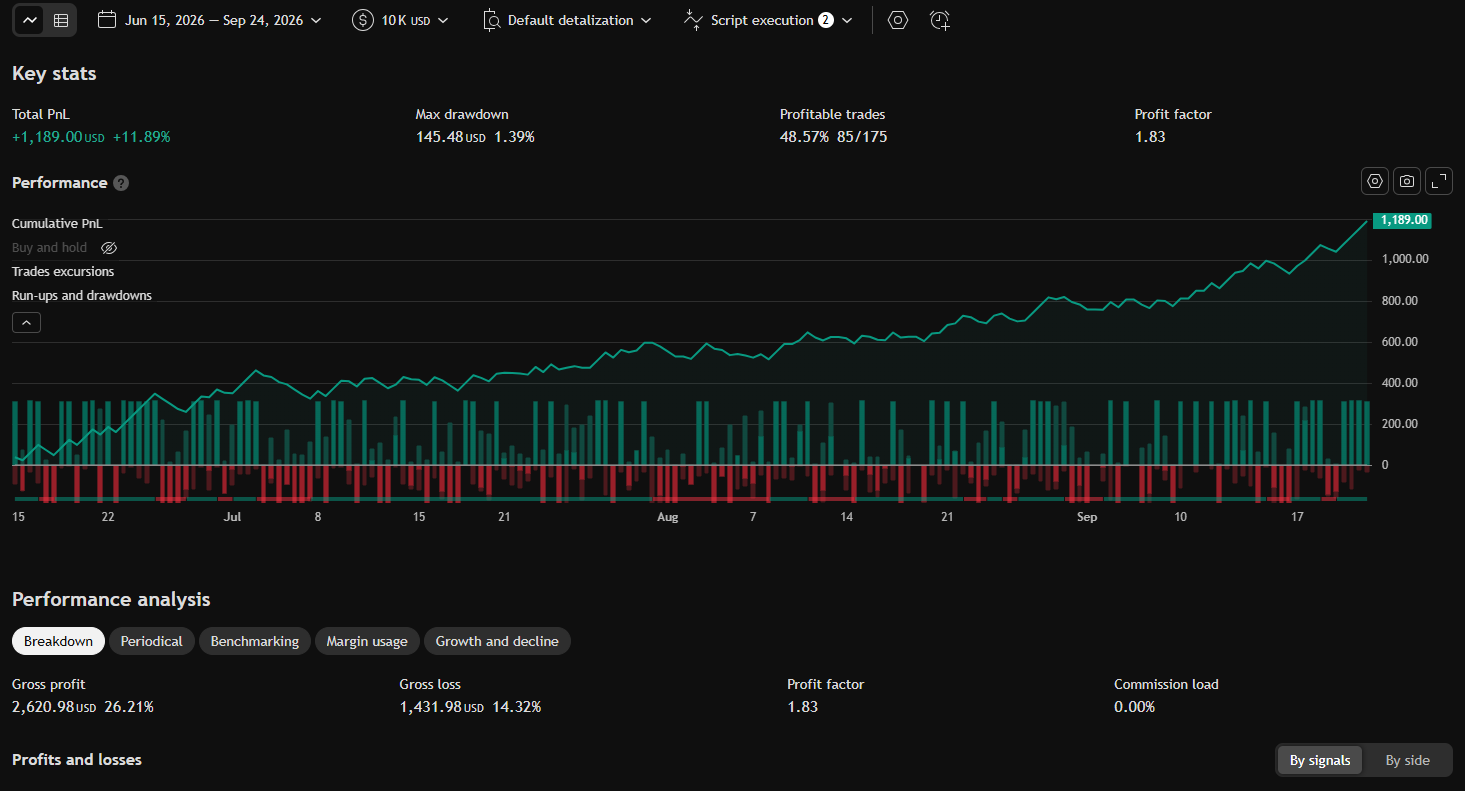
We ran the finished XAUUSD trading bot through the TradingView Strategy Tester on the OANDA feed. The test covered 8 June 2026 to 23 September 2026 — roughly 3.5 months and 182 closed trades — on a $10,000 starting account.
Headline Results
| Metric | Result |
|---|---|
| Net profit | +$1,232 (+12.32%) |
| Annualised return (CAGR) | 48.2% |
| Profit factor | 1.83 |
| Sharpe ratio | 2.88 |
| Win rate | 48.35% |
| Average win / average loss | 1.81 |
| Max drawdown (intrabar) | 1.38% |
| Total trades | 182 |
In plain terms: the bot won fewer than half its trades, but its winners were nearly twice the size of its losers. That is a healthy, trend-following profile, and the drawdown stayed remarkably shallow at 1.38%.
Long and Short Both Contributed
Importantly, the edge was not one-sided. Long trades produced a 1.97 profit factor with a 54% win rate, while short trades produced a 1.69 profit factor at a 43% win rate. A bot that only works in one direction is fragile, so seeing both sides profit is a good sign.
Parameter Analysis: Why Each Setting Matters
Every setting in this XAUUSD trading bot earns its place. Here is the reasoning behind the important ones.
| Setting | Value | Why we chose it |
|---|---|---|
| Stop loss | 0.25% | About 1.5× the M5 bar range — wide enough to survive noise. |
| Take profit | 0.375% | A 1.5-to-1 reward-to-risk target that gold reaches often. |
| TP buffer | 0.5% | Fills the target slightly early to avoid just-missed exits. |
| Hull Long length | 92 | Slow and strict, so longs only fire in confirmed up-trends. |
| Hull Short length | 27 + 44 | Fast, because gold sells off quicker than it rallies. |
| Sessions | London + NY | The only hours gold has the liquidity this bot needs. |
| Direction filter | DI+/DI− auto | The ADX direction engine blocks counter-trend entries. |
| Smart Filter L/S | On | Screens out low-quality signals on both sides. |
The theme is consistency: the stop, the target, the engine, and the session all point in the same direction — trade gold’s strong directional bursts, and stand aside during the chop.
Limitations and Honest Caveats
Strong backtest numbers are only the start, so here is what this result does not yet prove.
- The sample is short. Roughly 3.5 months covers one gold regime. It is promising evidence, not a long-run guarantee.
- The test assumed zero cost. Commission and slippage were set to zero. Real spread and slippage on gold will trim the net result, so treat the live edge as thinner.
- The Hull lengths look finely tuned. Settings that fit one window can overfit. We would re-test them over a longer history before trusting them.
- No forward validation yet. The bot still needs walk-forward and out-of-sample testing before any live capital.
None of this means the strategy is weak. It means the case study is honest about where it sits on the road from backtest to live trading.
Key Takeaways
- A gold XAUUSD trading bot must size its stop to real 5-minute volatility, not to a borrowed forex number.
- Hull Moving Averages, tuned asymmetrically, suit gold’s fast down-moves and slower up-moves.
- Session and swap discipline removed overnight risk and hidden cost.
- The backtest delivered a 1.83 profit factor and a 1.38% drawdown — strong, but on a short, cost-free sample that still needs forward testing.
Frequently Asked Questions
What is a XAUUSD trading bot? It is an automated strategy that buys and sells gold (XAUUSD) using fixed rules, with no manual input once it is running.
Which timeframe does this bot use? It runs on the 5-minute (5M) chart, using the OANDA gold feed inside TradingView.
Is this backtest a guarantee of future profit? No. Backtests describe the past under ideal conditions. Live results differ once real spread, slippage, and new market regimes are involved.
Risk disclaimer: This article is a technical case study for educational purposes only. It is not financial advice or a recommendation to trade. Trading gold and other leveraged instruments carries a high risk of loss. Past backtested performance does not guarantee future results. Never trade money you cannot afford to lose.