
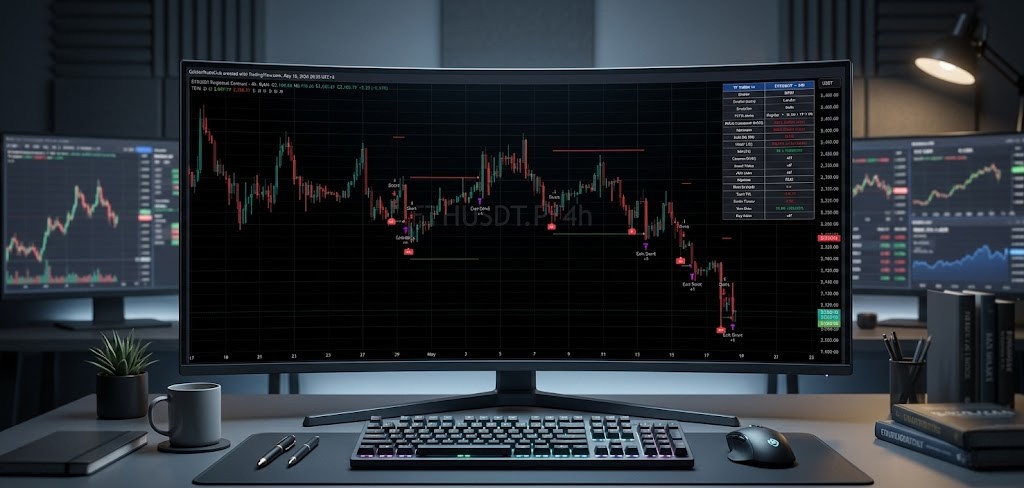
IQ TRADE Trading View Strategy
A configurable TradingView strategy framework — 21 entry triggers, regime filters, adaptive stops, webhook execution.
The IQ TRADE Strategy is a single TradingView Pine Script strategy that brings together every major technical-analysis family a serious trader uses — momentum, trend, structure, volatility, regime, volume, and mean reversion — into one configurable engine. You enable the triggers and filters you trust, the script handles entry timing, stop-loss and take-profit management, and forwards orders to your broker via webhook alerts. It works on crypto, forex, stocks, indices and metals.
Unlike a typical fixed-rule indicator, the IQ TRADE Strategy is a framework, not a black box. It does not promise a magic win rate. What it gives you is a high ceiling and the structure to reach it: every parameter is exposed, every trigger is documented, and every decision the script makes on a given bar is visible in the on-chart Status Dashboard.
Architecture in one minute
On every bar, the script asks five questions in order:
• Are we inside an allowed date, day-of-week, and session window? A UTC-based session model with eight pre-configured forex sessions plus a custom slot, and a per-weekday trading-days filter.
• Is the larger context favourable? A regime layer combining the LazyBear Squeeze “Smart Filter”, a MACD higher-timeframe confirmation filter, and an ADX/DMI regime gate.
• Did any enabled entry trigger fire? 21 long-side triggers and 21 mirrored short-side triggers, each with its own optional higher-timeframe selector.
• What is the position size, the stop loss, and the take profit? Three execution modes (Regular fixed-percent, Trailing ATR, Trailing Percent) with an ATR-anchored override and an ATR-percentile auto-adaptive mode for non-stationary volatility.
• Should any open position be closed? Exit triggers, trailing stops, session-end flatten, end-of-day flatten.
When all gates pass, an order goes out. The execution layer manages it through to exit.
The trigger library — what the script can see
The 21 long triggers (mirrored for shorts) are grouped into families that each capture a different way price tends to move:
• MACD family. Crossover, zero-line, and momentum-shift entries. Three MACD variants are selectable: Standard, MACD-V (volatility-normalised), and Zero-Lag MACD — every MACD trigger honours your choice.
• Ichimoku family. Kumo breakout, Tenkan/Kijun cross, and cloud-context entries, each with an independent higher-timeframe selector so a daily-cloud signal can fire on a one-hour chart.
• MACD & Ichimoku combos. Multi-condition entries that require both momentum and structural confirmation.
• Fair Value Gaps. ATR-thresholded gap detection with optional on-chart boxes.
• Trendline. Pivot-based trendline breaks with ATR, standard-deviation, or linear-regression slope.
• Hull MA family. Six Hull variants — primary, re-entry, and reverse for each side — supporting HMA, EHMA and THMA modes.
• Rolling VWAP. True volume-weighted average price over a configurable lookback, with Reclaim, Re-Entry (Bounce) and Reverse (Capitulation) variants on both sides.
• OBV / CVD / MFI Divergence. Regular bullish and bearish divergence between price and a chosen volume oscillator.
• Connors RSI(2) Mean Reversion. Short-period RSI pullbacks within an established trend, gated by a 200-period EMA.
Regime filters and adaptive stops
Triggers fire often. Filters decide which ones to act on. The Smart Filter, the MACD Confirmation Filter (with an optional stricter zero-line variant), and the ADX/DMI Regime Gate together let you trade only when the larger context agrees with the signal. The regime gate also includes a Trade Direction Auto mode where DI+/DI− drives long-versus-short selection.
Stops and targets are equally flexible. Use fixed-percentage SL and TP, or switch to ATR-anchored TP and SL — the more robust real-world method that scales stops to current volatility. The ATR-percentile auto-adaptive mode goes further, scaling distances by where current volatility sits in its rolling percentile window. Symbol-class presets (crypto, forex, stocks, metals, indices) apply sensible multipliers as a starting point.
Multi-timeframe by design
Almost every trigger has its own higher-timeframe selector. You can run the strategy on a 1-hour chart while pulling the Ichimoku cloud from the daily, the MACD from the 4-hour, and the Hull from the chart timeframe. This is what makes the IQ TRADE Strategy a true multi-timeframe TradingView strategy, not a single-resolution indicator.
Execution: alerts to your broker
The script ships with pre-built alert payload templates for 3Commas, ByBit, Binance, OKX, and a generic JSON format your own webhook can consume. Set up a TradingView alert, paste the configured message, and the strategy hands off orders to your execution layer at the moment the signal fires.
The companion: IQ TRADE Optimizer
Every IQ TRADE Strategy subscription includes the IQ TRADE Optimizer, a parameter-sweep indicator that ranks Hull lengths, VWAP lengths, Trendline parameters, and TP/SL combinations in a single chart load. Use it to narrow the search space before you fine-tune by hand inside the Strategy. It is the practical answer to “which parameter values would have worked best on this symbol and timeframe?” — without re-running the Strategy by hand twenty times.
Honest expectations
The IQ TRADE Strategy is architecturally complete, but profitability comes from how you configure it, not from any default. With well-tuned per-symbol settings, walk-forward validation, and disciplined size management it can place you ahead of the vast majority of retail bots. It does not predict the future, it does not auto-tune in-script, and it does not turn arbitrary settings into edge. Treat configuration — guided by the included manual — as the actual product.
Try IQ TRADE for 7 days, free
No charge until day 8. Cancel any time during the trial. See plans at iqtrade.ai/home.
Risk disclaimer
Trading carries risk and is not suitable for everyone; you can lose money. IQ TRADE provides software tools and educational material, not financial, investment, or trading advice. Past or backtested performance is not indicative of future results. See our Terms of Use for the full risk disclosure.